When we talk about raptors, images of majestic eagles or soaring Red-tailed Hawks often come to mind, right? But let me tell you, there's another bird of prey, a truly incredible one, that often operates right under our noses, especially if you live in suburban or even urban areas. I'm talking about the Cooper's Hawk. For me, seeing one in action is always a thrill. It's like witnessing a perfectly orchestrated natural drama unfolding before your eyes, often startlingly close to home.
Unmasking the Cooper's Hawk: What to Look For
Identifying a Cooper's Hawk can sometimes be a bit tricky, especially if you're new to bird watching. They bear a resemblance to their smaller cousin, the Sharp-shinned Hawk, which can definitely throw you off. However, with a little practice, you'll start to notice those key differences. Trust me, I've spent hours trying to tell them apart!
Key Identification Marks
- Size and Shape: Cooper's Hawks are medium-sized hawks, generally about 14 to 20 inches long with a wingspan of 27 to 36 inches. Females are notably larger than males, which is common among raptors. Their body shape is quite distinct: they've got a relatively large head that projects beyond the wings in flight, giving them a sort of "T-shaped" silhouette. Contrast that with a Sharp-shinned, which often looks like it has a tiny head.
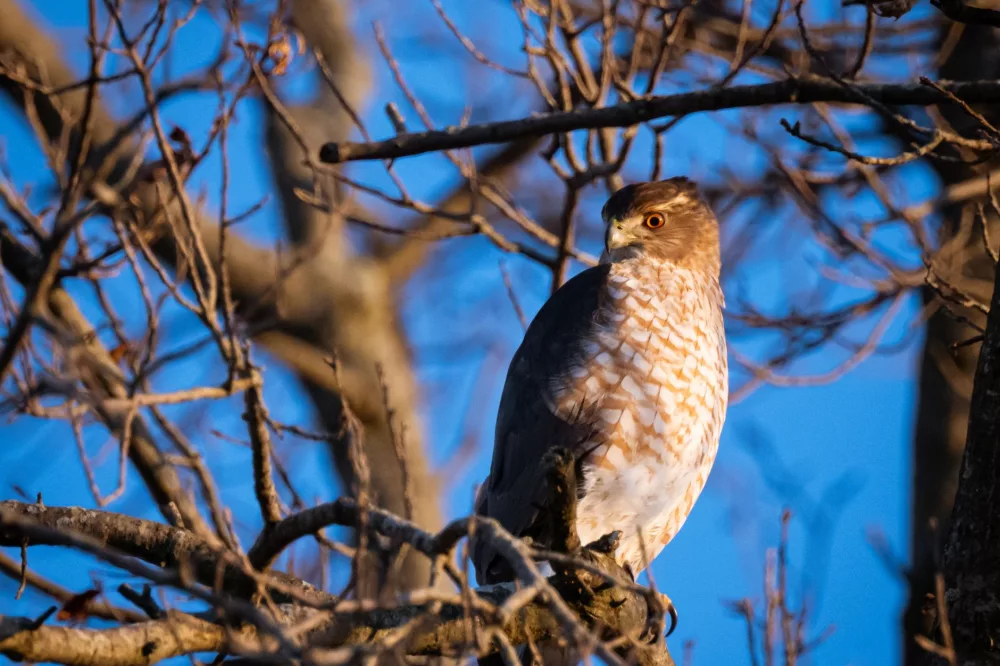
- Plumage: Adults boast a striking appearance. They have a blue-gray back and head, with a rufous (rusty orange) barred underside. Their eyes are a fiery red, which is just captivating. Juveniles, on the other hand, are quite different. They have a brown back and a streaky brown and white underside, often with yellow eyes.
- Tail: Pay close attention to the tail; it's a dead giveaway. Cooper's Hawks have a long, rounded tail with dark bands, and the outer tail feathers are shorter than the central ones, creating that rounded look. Sharp-shinned Hawks, conversely, usually have a squared-off or slightly notched tail.
- Flight Style: They're incredibly agile fliers. You'll often see them flying with several quick wing beats followed by a glide, or they might engage in a dramatic chase through dense woodland. They’re built for speed and maneuverability, not soaring high like a Buteo hawk.
Their Domain: Where Do Cooper's Hawks Live?
One of the most fascinating things about Cooper's Hawks is their adaptability. They're not just confined to pristine wilderness areas; you can find them across North America, from southern Canada all the way down through the United States and into parts of Mexico. My experiences with them have often been right in my own neighborhood, which still surprises me sometimes.
Originally, these birds were primarily denizens of mature woodlands. Think dense forests with tall trees, perfect for nesting and ambushing unsuspecting prey. However, over the past few decades, they've shown an incredible ability to adapt to human-modified landscapes. Today, it's not uncommon to spot them in suburban parks, backyards with plenty of trees, and even urban green spaces. They've learned to thrive alongside us, which is pretty cool if you ask me.
The Art of the Hunt: A True Avian Assassin
Watching a Cooper's Hawk hunt is like watching a master strategist at work. They are predominantly bird eaters, though they'll certainly grab small mammals like squirrels, chipmunks, or even lizards if the opportunity arises. Their hunting technique is what truly sets them apart; it's all about surprise and speed.
They'll often perch quietly, concealed within foliage, patiently waiting for an unsuspecting songbird to pass by. Then, in a sudden burst of acceleration, they'll launch themselves, weaving through branches at an unbelievable pace. I've personally seen one pursue a dove through a hedge line, banking sharply and barely missing a twig. It's breathtaking!
A Typical Diet Might Include:
- Doves
- Jays
- Robins
- Starlings
- Finches
- Various other small and medium-sized birds
- Small rodents like mice and voles
- Occasionally, frogs or insects
Their powerful talons are their primary weapon, designed to grasp and quickly dispatch prey. They're not afraid to get into tight spaces, like dense shrubs or even porch awnings, if it means catching a meal. This bold approach can sometimes put them in conflict with backyard bird feeders, but it's just nature running its course.
Nesting and Family Life
Breeding season for Cooper's Hawks typically begins in spring. Both parents participate in nest building, constructing a sturdy platform of sticks high in a tree, often in a deciduous or mixed forest. They might even reuse an old squirrel nest or another raptor's nest, simply adding their own touches.
The female usually lays 3 to 5 pale, bluish-white eggs. Incubation lasts about 30 to 36 days, primarily by the female, while the male does most of the hunting to feed her. Once the young hatch, they are completely helpless, covered in down. Both parents work tirelessly to bring food to the nest, with the young birds fledging (taking their first flight) about 27 to 34 days after hatching. Even after fledging, the young will stay with their parents for several weeks, learning essential hunting skills before striking out on their own. It's a significant commitment from the parents, ensuring the next generation has the best possible start.
Conservation and Coexistence
For a while, Cooper's Hawk populations faced significant declines, primarily due to the widespread use of pesticides like DDT in the mid-20th century. These chemicals thinned eggshells, leading to reproductive failure. Thankfully, with the ban of DDT and increased conservation efforts, their numbers have made a remarkable recovery. It's a great conservation success story, showing what can happen when we act responsibly.
Today, they're considered a species of least concern. However, they still face challenges, like habitat loss and collisions with windows or vehicles, especially in developed areas. As they adapt more to urban and suburban environments, understanding and appreciating these birds becomes even more important. We need to remember that our backyards are part of their hunting grounds. So, if you see one, respect its space and marvel at its wild beauty.
I find it truly inspiring how these birds have bounced back and learned to navigate our changing world. They're a reminder that wildness isn't always far off in a national park; sometimes, it's just outside your window, a Cooper's Hawk perched on a branch, scanning for its next meal. It's a powerful thought, really, how resilient nature can be. They're a testament to the enduring wild spirit that thrives even in unexpected places.